Written by United Planet Correspondent Maya Marshall
 I’ve encountered myriad cultural differences since I’ve been in Brazil. The people work differently, drive differently, and eat differently, but the most prominent and potentially frustrating cultural difference that I’ve encountered is the language. The process of learning a new language is incredible, and I suspect it is a process that never ends. New layers of communication reveal themselves regularly even in our native languages. It is thrilling when you realize that you can’t just translate directly, that meaning changes from one person to the next, and that so much of communication is physical. Gesture does most of the work for us.
So, after two weeks of feeling isolated, smiling awkwardly in social situations, and gesticulating wildly at clerks in stores, I finally enrolled in the Capoeira class that I said I’d join. In addition to listening to the radio, watching telenovelas, and reading solely in Portuguese, my Capoeira class has helped me improve my language skills.
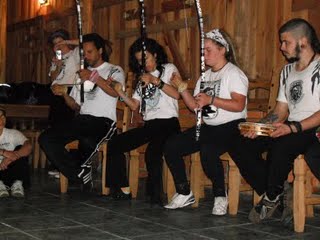 Taking a class at a community gymnasium has renewed the confidence I lost when I found I was suddenly illiterate. Verbal communication got me a coffee that I didn’t want and put me on a bus to the wrong part of town. It also put me in a position to make friends with locals—people with whom I can practice my Portuguese. I see these people two or three times a week, and since the class is all about movement and playing music it’s easy to participate. It’s a non-judgmental atmosphere; since, everyone in the class is there to learn.
Capoeira is a dance/martial art which celebrates inclusion. Men play women, children play adults, many races are represented, and everyone shows respect for other players and for the communion in which we partake. And like I said, gesture plays a crucial role in communication so when our instructor says “lift your right leg” or do the sequence in the other direction, I learn words like, lado, frente, and perna. When we sit together at the end of the night to ask questions and to discuss the music, rituals, and movements involved in play, I get to listen to a regular conversation rather than something scripted. Facial expressions and gestures are organic and I find that I’m understanding the content; I’m learning words by intuition, repetition and demonstration. And since I’m part of this group—I belong to it—I feel less foreign, and I feel comfortable asking questions not only about Capoeira but also Portuguese.
ABOUT UNITED PLANET
United Planet is a non-profit organization with a mission to create a global community, one relationship at a time. Established in 2001, United Planet offers volunteer abroad, virtual internships, internships abroad, gap year volunteering, and global virtual exchange in more than 40 countries.